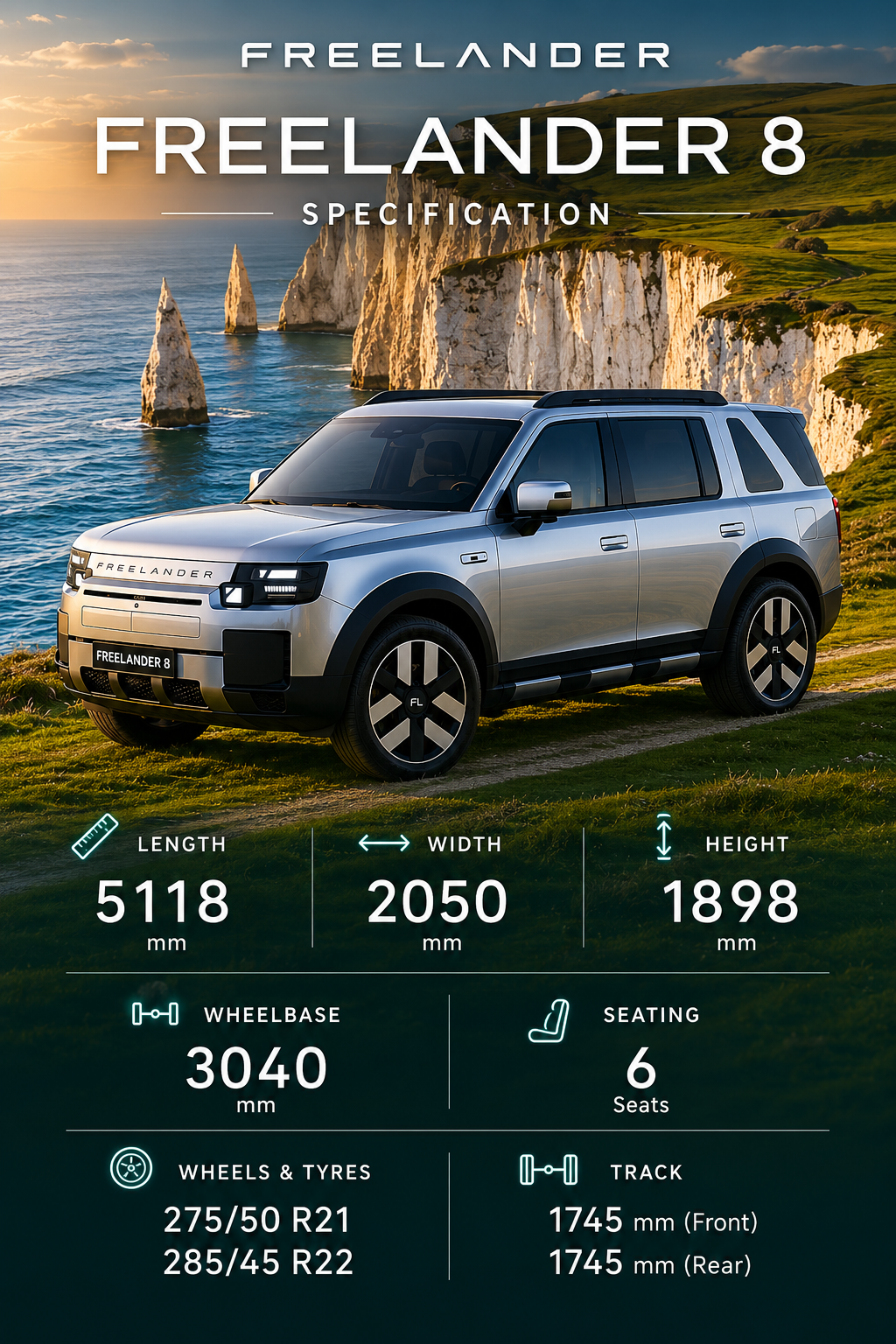
The picture surrounding the new Freelander 8 is slowly becoming clearer.
Over the past few weeks, information has emerged regarding the vehicle's dimensions, seating configuration and global rollout plans.
Now attention is turning to what may ultimately be the most important question of all:
How will it be powered?
Recent information circulating on Chinese social media suggests the Freelander 8 will be offered with more than one electrified powertrain option.
And that could make it attractive to a much wider audience than many initially expected.
A Full Battery Electric Vehicle
The most obvious version is a pure battery electric vehicle (BEV).
For many buyers, this is exactly what they want.
No petrol engine.
No fuel tank.
No servicing requirements associated with a traditional internal combustion engine.
Just batteries, electric motors and instant torque.
As charging infrastructure continues to improve around the world, many drivers see a full EV as the cleanest and most elegant solution.
It is likely to appeal particularly to urban drivers and those with access to home charging.
But There Appears To Be Another Option
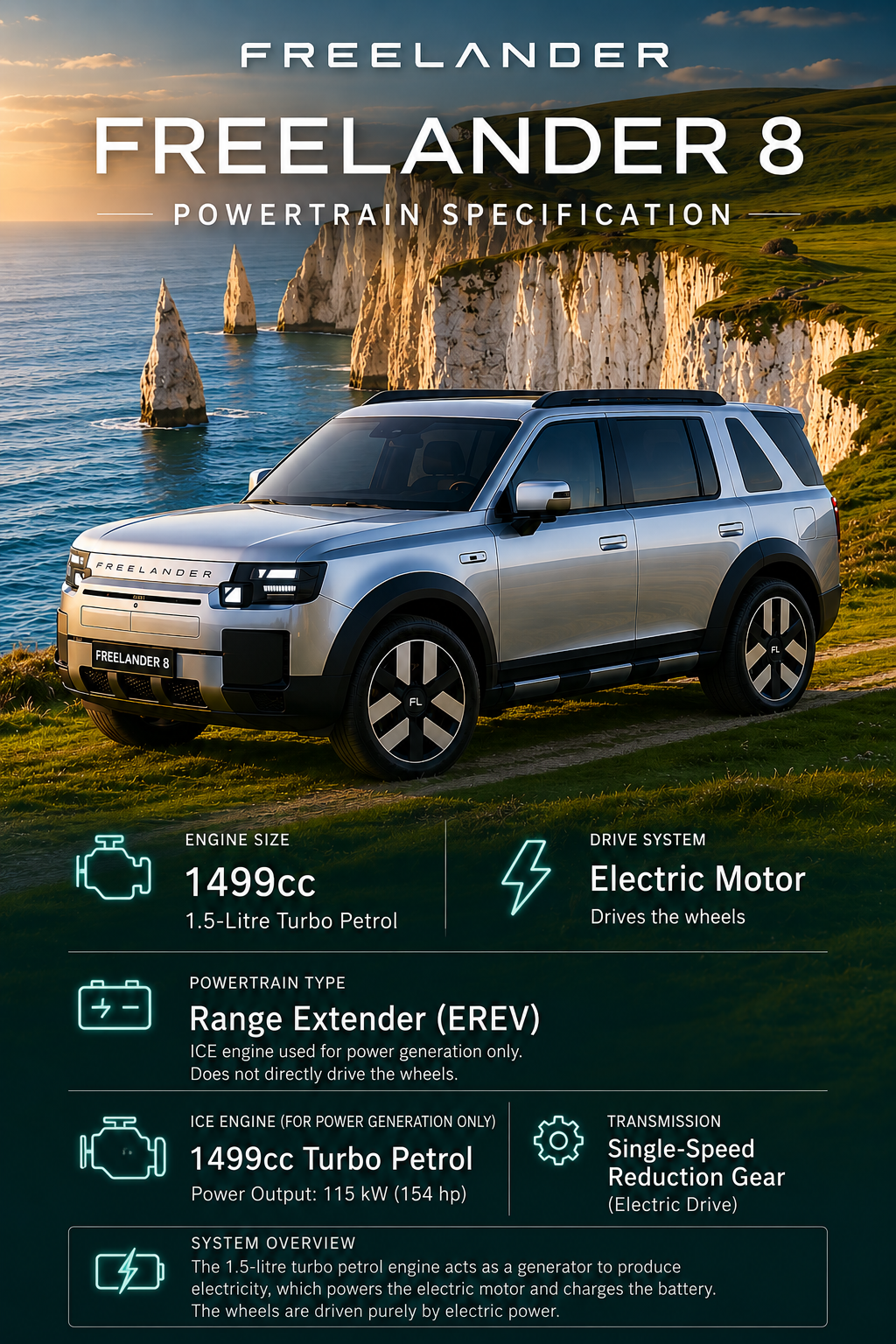
The latest information suggests Freelander may also offer a range-extended electric vehicle, often referred to as an EREV or REX.
This is where things become particularly interesting.
Unlike a conventional hybrid, a range extender is still fundamentally an electric vehicle.
The wheels are driven by electric motors.
However, a small petrol engine is carried on board and acts as a generator when required.
Its job is not to drive the wheels directly.
Instead, it produces electricity to charge the battery and extend the vehicle's driving range.
Recent reports suggest Freelander could use a 1.5-litre turbocharged petrol engine producing around 115 kW (154 hp) as part of this system.
The Best Of Both Worlds?
Supporters of range-extender technology argue that it combines many of the benefits of a battery electric vehicle with the convenience of a conventional car.
For everyday journeys, drivers can operate almost entirely on electric power.
For longer trips, the petrol engine can generate electricity when needed, reducing concerns about finding a charger.
In theory, it offers:
- Electric driving experience
- Instant torque
- Reduced charging anxiety
- Greater flexibility on long journeys
- Potentially smaller battery requirements
For many buyers, that combination could prove highly attractive.
Not Everyone Will Be Convinced
Of course, some EV enthusiasts will question the need for a petrol engine at all.
One of the biggest attractions of a full battery electric vehicle is its simplicity.
No engine.
No exhaust system.
No fuel tank.
No additional mechanical complexity.
To these buyers, carrying an internal combustion engine simply to generate electricity may feel like an unnecessary compromise.
As battery technology continues to improve, some argue that range extenders are merely a stepping stone on the path towards fully electric vehicles.
Range Figures Still Unknown
Perhaps the biggest missing piece of the puzzle is range.
At the time of writing, Freelander has not officially released battery capacity figures, electric-only range figures or total combined range figures.
Those numbers will be crucial.
A range extender only makes sense if it delivers a meaningful advantage over a conventional battery electric vehicle.
Until the official specifications are released, we can only speculate.
A Sensible Strategy?
Offering both BEV and range-extender versions could prove to be a very smart move.
Different markets are developing at different speeds.
Some regions now have extensive charging infrastructure and strong EV adoption.
Others still present challenges for long-distance electric travel.
By offering both options, Freelander may be able to appeal to a much broader audience.
The pure EV will attract buyers who want the cleanest possible electric driving experience.
The range-extender could appeal to those who like the idea of electric driving but are not yet ready to give up the reassurance of having an onboard power source.
The Picture Is Becoming Clearer
A few months ago, the new Freelander 8 was little more than a name and a handful of teaser images.
Today we know it is a large six-seat SUV with a wheelbase of more than three metres, ambitions to become a global brand, and now what appears to be a choice of electrified powertrains.
There are still many questions left unanswered.
But with every new piece of information released, Freelander is beginning to look less like a concept and more like a serious contender in the rapidly growing electric SUV market.
By Simon Jefferson